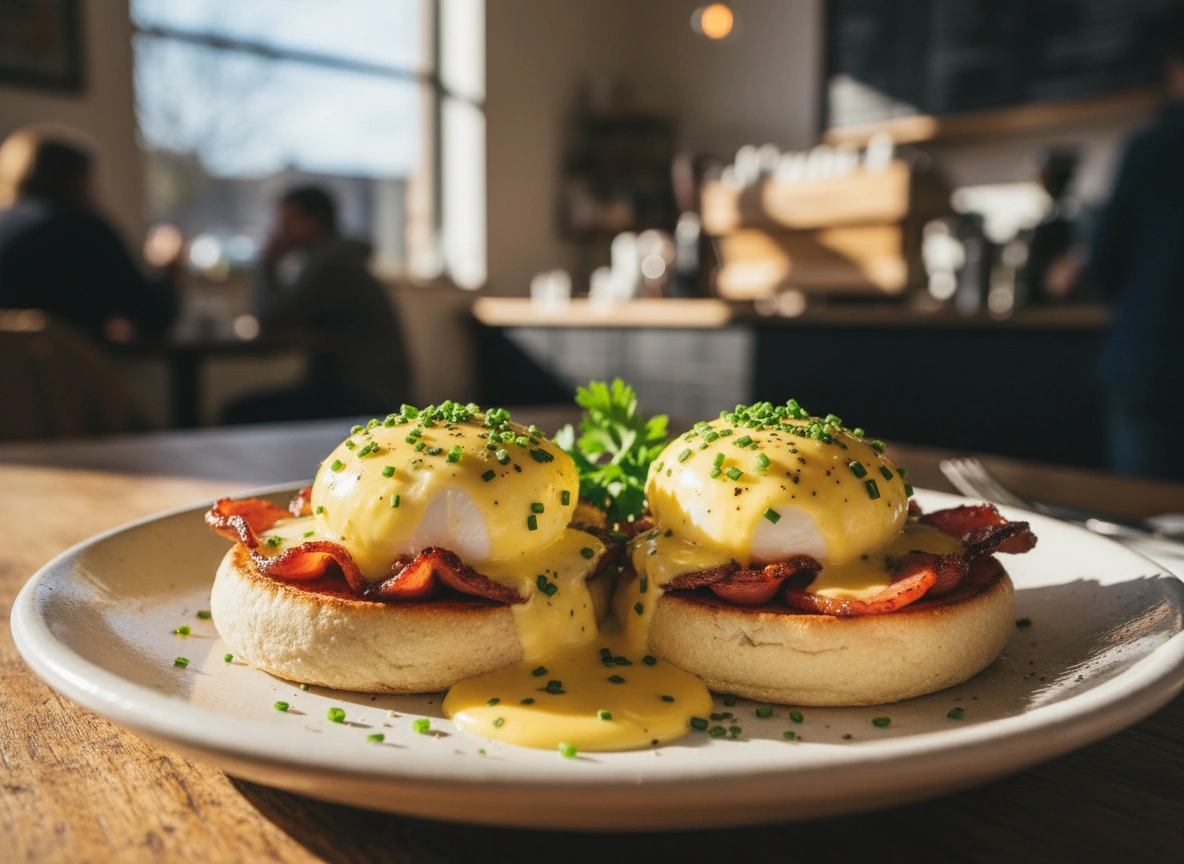
There is a precise moment of truth in every brunch service. It happens when a diner takes their knife to a poached egg sitting atop a toasted muffin. If the yolk resists slightly before yielding a slow, golden lava flow that mingles perfectly with the hollandaise, the kitchen has succeeded. If it is rubbery or, conversely, watery and undercooked, the illusion of a perfect morning is shattered.
Eggs Benedict is deceptively simple. It requires only four main components: bread, meat (or spinach), eggs, and sauce. Yet, it is one of the most difficult dishes to execute consistently. Among the sea of brunch spots attempting this classic, Café Yolk has carved out a reputation for excellence. Their version of Eggs Benedict isn’t just breakfast; it is a masterclass in culinary balance.
This article explores the specific elements that elevate Café Yolk’s recipe above the competition. We will dissect the quality of their ingredients, the precision of their technique, and the attention to detail that transforms a standard menu item into a must-have dining experience.
The Foundation: Sourcing the Right Ingredients
You cannot cook a five-star meal with one-star ingredients. The philosophy at Café Yolk centers on the idea that in a dish with so few components, there is nowhere to hide. Every element must be exceptional on its own before it can contribute to the whole.
The Eggs: Freshness is Non-Negotiable
The namesake of the establishment, the yolk, is naturally the priority. Café Yolk utilizes high-welfare, free-range eggs sourced from local farms. This isn’t just a buzzword for the menu; it impacts the chemistry of the dish.
Fresh eggs have tighter proteins in the white (albumen). When a fresh egg is cracked into poaching water, it holds its shape naturally. Older eggs tend to spread, creating wispy, unappealing strands of white that must be trimmed away. Furthermore, the diet of the hens dictates the flavor and color of the yolk. Café Yolk’s eggs are characterized by a deep, vibrant orange hue and a rich, creamy texture that stands up to the acidity of the sauce.
The Bread: Structural Integrity
A common failure in Eggs Benedict is the “soggy bottom” phenomenon. If the bread is too airy or not toasted correctly, the moisture from the egg and the fat from the sauce turn the base into mush.
Café Yolk opts for an artisanal approach. Whether using a traditional English muffin or a slice of high-quality sourdough, the key is the crumb density. Their bread choice offers a distinct chew and a fermented tang that cuts through the richness of the toppings. It is toasted to a deep golden brown, creating a barrier that remains crisp until the very last bite.
The Meat: Quality Cuts Over Processed Slices
While the traditional recipe calls for Canadian bacon, Café Yolk understands that texture contrasts are vital. They avoid the wafer-thin, watery ham found in lesser establishments. Instead, they utilize thick-cut, carved ham or premium smoked bacon. This provides a salty, savory punch that anchors the dish. The meat is seared just before assembly, ensuring caramelized edges that add a necessary crunch and warmth.
The Chemistry of the Sauce: A Hollandaise Masterpiece
The true test of any breakfast chef is their Hollandaise. It is one of the five “mother sauces” of French cuisine, an emulsion of egg yolk, liquid butter, and acid (usually lemon juice or vinegar). It is notoriously temperamental. If it gets too hot, it scrambles; too cool, it solidifies; stir it incorrectly, and it splits into a greasy mess.
Café Yolk’s Hollandaise stands out for three specific reasons:
- The Temperature Balance: They serve their sauce at the perfect ambient warmth. It is hot enough to comfort the palate but not so hot that it continues to cook the poached egg beneath it.
- The Acid Profile: Many recipes are too heavy on the butter, leaving a greasy aftertaste. Café Yolk increases the acidity slightly, using fresh lemon juice and a reduction of vinegar infused with peppercorns. This sharpness is essential. It acts as a palate cleanser, cutting through the fat of the egg yolk and butter, making the dish feel lighter than it actually is.
- The Texture: Their emulsion is aerated to perfection. It is velvety and thick enough to coat the back of a spoon (nappe consistency) but light enough to drape elegantly over the egg without glooping.
The Technique: Precision Poaching
Why do home cooks struggle to replicate the Café Yolk experience? Usually, it comes down to the poaching technique. The kitchen at Café Yolk treats poaching as a science, not a guessing game.
Water Chemistry and Temperature
The kitchen maintains the poaching water at a gentle simmer, never a rolling boil. Violent bubbles tear delicate egg whites apart. While many assume vinegar is the secret to keeping an egg together, too much vinegar makes the whites rubbery and imparts an unpleasant sour taste. Café Yolk uses a minimal amount of acid in the water, relying instead on the freshness of the egg and the “vortex” method—creating a gentle whirlpool to wrap the white around the yolk—to ensure a uniform shape.
The Timing
Consistency is the hallmark of professionalism. The chefs at Café Yolk have dialed in the timing to the second. The goal is a white that is fully set and opaque—no one wants to see clear, slimy raw egg—while the yolk remains completely liquid. This precise thermal window is small, often a matter of 30 seconds between “perfect” and “soft boiled.”
Presentation and Variation: The Visual Feast
We eat with our eyes first, and Café Yolk capitalizes on the visual appeal of the Benedict. The plating is deliberate. The muffins are stacked to create height, rather than laid flat, giving the dish a grand, architectural appearance.
The Garnish
The dish is finished with a sprinkle of fresh herbs—usually chives or micro-greens—and a dusting of paprika or cayenne pepper. This isn’t just for color; the cayenne adds a microscopic kick of heat that wakes up the taste buds, enhancing the savory notes of the ham and the brightness of the lemon.
Modern Twists
While the classic recipe is a staple, Café Yolk’s “Stand Out” factor also comes from their willingness to innovate. They apply their rigorous technical standards to variations that cater to modern palates:
- The Royale: Replacing ham with high-grade smoked salmon. The smokiness of the fish pairs exceptionally well with their lemon-forward Hollandaise.
- The Florentine: A vegetarian option using wilted spinach. Crucially, the kitchen ensures the spinach is thoroughly drained and seasoned with nutmeg, preventing the dreaded watery plate that ruins many Florentines.
The Customer Verdict: Consistency is King
Ultimately, a recipe is only as good as its execution on a busy Sunday morning. What truly makes Café Yolk’s recipe stand out is consistency. Browse through reviews and customer feedback, and a pattern emerges: the Eggs Benedict they ordered three years ago tastes exactly as good as the one they ordered today.
In the restaurant industry, this reliability is the hardest currency to earn. It suggests rigorous staff training and an uncompromising adherence to the recipe’s standards. When a customer orders the Benedict here, they aren’t gambling; they are investing in a guaranteed experience.
Conclusion
The perfect Eggs Benedict is a symphony of fats and acids, textures and temperatures. It is easy to make mediocrity, but it takes dedication to produce excellence. Café Yolk’s recipe stands out not because of a single secret ingredient, but because of a holistic commitment to quality.
From the sourcing of deep-orange yolks and artisan breads to the scientific precision of their emulsion and poaching times, every step is calculated to maximize pleasure. For the food enthusiast, Café Yolk offers more than just a meal; they offer a standard against which all other brunches should be measured.
If you have yet to experience it, the recommendation is simple: go early, bring an appetite, and prepare to have your standards for Eggs Benedict permanently raised.Please visit website for more info.
You may also read: Dog-Friendly Cafés in Reading: Why Café Yolk Is #1