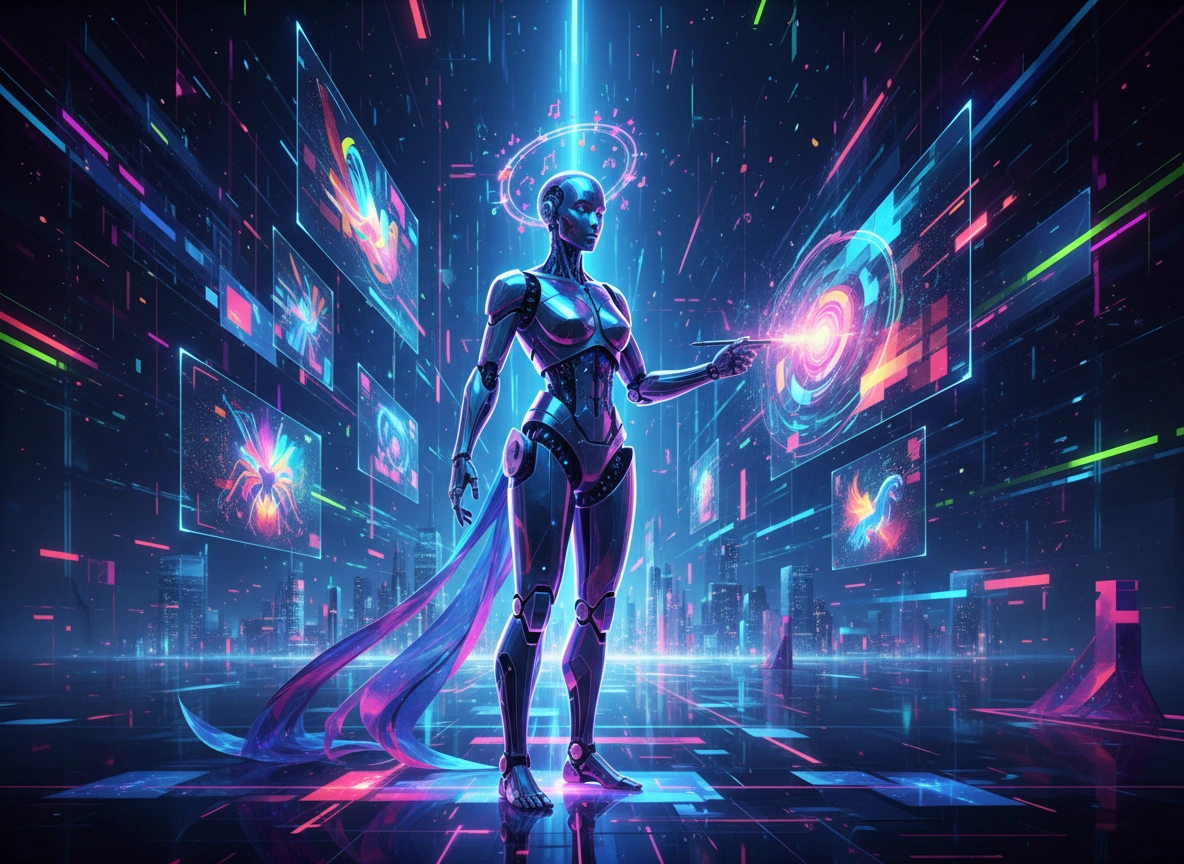
Artificial intelligence is rapidly reshaping industries across the globe, and the creative fields are no exception. Once seen as a realm exclusively governed by human intuition and emotion, the creative process is now intersecting with powerful AI algorithms. This fusion is not just an experiment; it’s a growing movement that is changing how art, music, writing, and design are conceived, produced, and experienced. By automating tedious tasks, generating novel ideas, and offering new tools for expression, AI is becoming an influential co-creator.
This article explores the significant impact of AI on the creative industries. We will examine how these technologies are being used in various fields, from generating visual art to composing music. We’ll also weigh the considerable benefits against the valid concerns and ethical questions that arise, before looking ahead to the future of this dynamic partnership between human and machine.
AI’s New Role in the Creative Process
For decades, digital tools have assisted creatives, but AI introduces a new dimension: partnership. Instead of just being a passive instrument, AI can actively participate in creation. This collaboration is manifesting in unique ways across different sectors, augmenting human capabilities and pushing the boundaries of what is possible.
Visual Arts and Design: From Pixels to Masterpieces
The world of visual art and design has been one of the most visible arenas for AI’s creative influence. AI-powered tools are now capable of generating stunningly complex and original images from simple text prompts.
- Generative Art: Platforms like Midjourney and DALL-E 2 have brought text-to-image generation to the mainstream. Artists and designers can input descriptive phrases—such as “a futuristic city in the style of Van Gogh”—and receive a unique visual interpretation within seconds. This allows for rapid ideation and the exploration of visual concepts that would otherwise take hours or days to sketch.
- Graphic Design: In graphic design, AI is accelerating workflows. Tools like Adobe Sensei can automate repetitive tasks such as object selection, background removal, and color correction. Other AI platforms can generate logo variations, suggest layout improvements, and even create entire brand identity kits based on a few user inputs, freeing designers to focus on higher-level strategic thinking.
- Data Visualization: AI algorithms can analyze vast datasets and transform them into compelling visual narratives. This is particularly useful in fields like journalism and scientific research, where complex information must be presented in a clear and understandable format.
The Sound of Algorithms: AI in Music and Audio
Music, with its mathematical foundations in rhythm, melody, and harmony, is a natural fit for AI. AI tools are now assisting in every stage of music production, from composition to mastering.
- Composition and Songwriting: AI-powered software can generate original melodies, chord progressions, and even entire song structures in various genres. Amper Music and AIVA (Artificial Intelligence Virtual Artist) are examples of platforms that create royalty-free music tailored to specific moods or durations, which is invaluable for content creators, filmmakers, and game developers.
- Audio Production: AI helps streamline the technical side of music production. Tools like iZotope’s Ozone and Neutron use machine learning to analyze audio tracks and suggest optimal settings for equalization, compression, and mastering. This makes professional-grade sound more accessible to independent artists and producers.
- Voice Synthesis: The technology behind voice assistants has evolved into sophisticated AI voice synthesis. It’s now possible to create realistic vocal tracks from text or even clone a person’s voice for applications in audiobooks, podcasts, and character voice-overs in entertainment.
The Ghost in the Machine: AI and the Written Word
Writing is another creative domain where AI is making significant inroads. While the idea of an AI writing a bestselling novel remains a subject of debate, its role as a writing assistant is firmly established.
- Content Generation: AI models like GPT-4 are capable of generating coherent and contextually relevant text on a vast range of topics. They are used to draft articles, marketing copy, emails, and social media posts. This allows writers and marketers to overcome writer’s block and produce initial drafts quickly.
- Editing and Proofreading: Advanced grammar checkers like Grammarly and ProWritingAid use AI to go beyond simple spell-checking. They analyze sentence structure, tone, clarity, and style, offering suggestions to improve the overall quality of the writing.
- Narrative Assistance: Some tools are being developed to help screenwriters and novelists with plot development, character creation, and dialogue. These systems can suggest plot twists, generate character backstories, or help structure a narrative, acting as a creative sounding board.
The Benefits and Challenges of AI in Creativity
The integration of AI into creative workflows brings a host of advantages, but it also raises important questions and concerns that the industry must navigate.
The Upside: Efficiency, Accessibility, and Innovation
The most immediate benefit of AI is the tremendous boost in efficiency. By automating time-consuming and repetitive tasks, AI allows creators to dedicate more time and energy to the conceptual and strategic aspects of their work. This democratization of tools also lowers the barrier to entry; someone without formal training in music theory can compose a soundtrack, and a small business owner can design a professional-looking logo.
Furthermore, AI can be a powerful catalyst for innovation. It can generate unexpected combinations of ideas, styles, and patterns that a human creator might not have considered. This ability to produce “happy accidents” can spark new creative directions and push artistic boundaries.
The Downside: Authenticity, Ethics, and Devaluation
Despite the benefits, the rise of AI in creative fields is met with apprehension. A primary concern is the question of authenticity and originality. If an artwork is generated by an algorithm, who is the artist? This debate extends to copyright law, which is still catching up to the concept of machine-generated content.
There are also significant ethical considerations, particularly regarding the data used to train these AI models. Many generative models are trained on vast datasets of existing art, music, and text scraped from the internet, often without the original creators’ consent or compensation. This has led to accusations of style plagiarism and concerns that AI could perpetuate biases present in its training data.
Finally, there is a fear that the proliferation of AI-generated content could devalue human skill and creativity. If high-quality creative work can be produced instantly and at a low cost, it could depress the market for human artists, writers, and designers, making it harder for them to sustain a career.
The Future: A Collaborative Horizon
The future of creativity is unlikely to be a battle of human versus machine. Instead, it will be a story of collaboration. AI will become an increasingly integrated part of the creative toolkit, a partner that augments rather than replaces human talent. The most successful creators will be those who learn to leverage these tools effectively, using them to enhance their vision and streamline their process.
We can expect AI models to become even more sophisticated and intuitive, capable of understanding nuanced instructions and producing more refined outputs. The focus will shift from simple generation to fine-tuned control, allowing creators to guide the AI with greater precision. As this technology evolves, new art forms and creative genres will emerge that are uniquely native to this human-AI partnership.
In conclusion, the rise of AI in the creative industries represents a fundamental shift in how we think about and produce art. It offers incredible opportunities for efficiency, accessibility, and innovation. However, it also demands a thoughtful approach to the ethical, legal, and economic challenges it presents. By embracing AI as a collaborative tool while actively addressing its complexities, the creative community can unlock a new era of expression and ingenuity, one where technology serves to amplify the very human spark of imagination.
Please visit this website for more info