The office cubicle is rapidly becoming a relic of the past. For decades, the 9-to-5 grind in a centralized office was the undisputed default for knowledge workers. However, the last few years have shattered that norm, accelerating a shift that was already bubbling under the surface. We are no longer asking if work will change, but how it will settle.
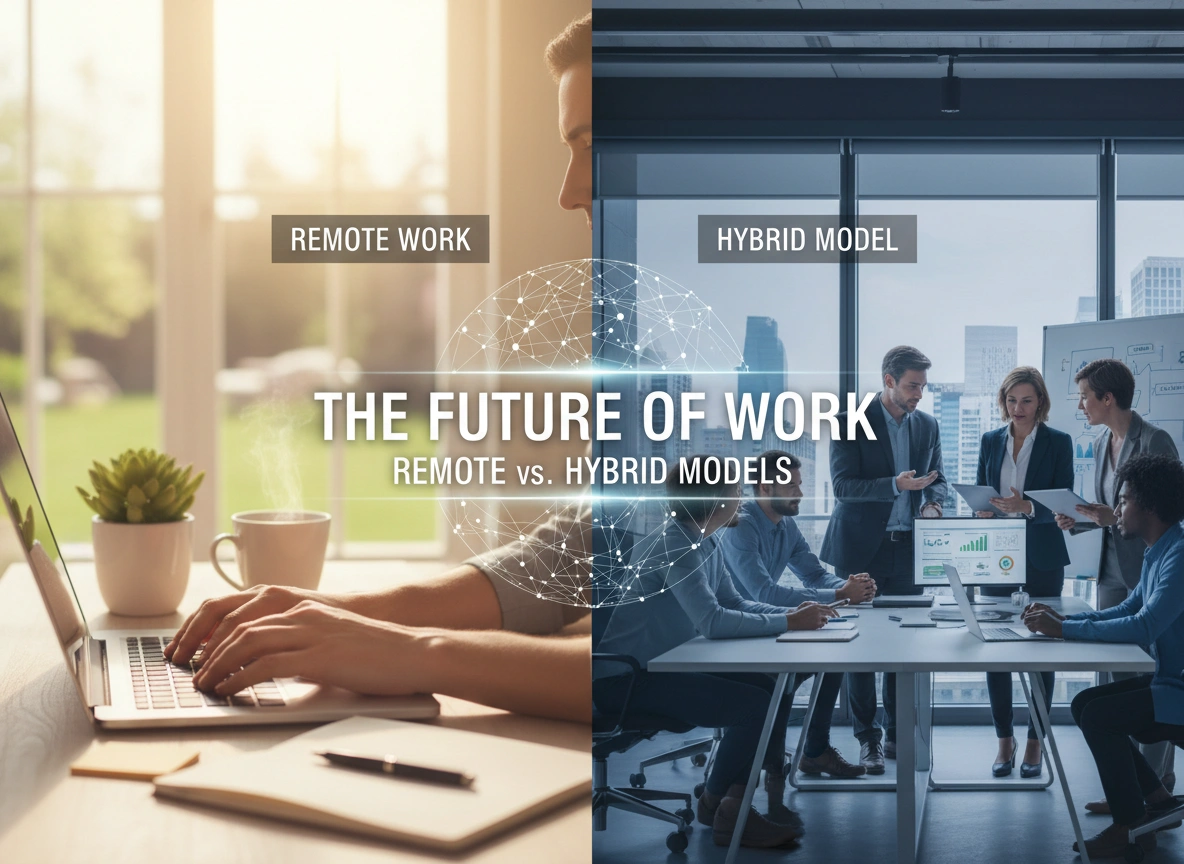
As businesses and employees navigate this new landscape, two dominant contenders have emerged: fully remote work and the hybrid model. While both offer freedom from the traditional commute, they present vastly different visions for the future of productivity, collaboration, and company culture.
This article explores the deep implications of this shift. We will examine the mechanics of both models, weigh their pros and cons, and look ahead to see how technology and human preference will shape the next decade of employment.
The Great Uncoupling: How We Got Here
To understand where we are going, we have to look at what we left behind. The traditional office model was born out of the Industrial Revolution—a time when efficiency meant having everyone in one place to operate machinery. That logic carried over into the information age, even when the “machinery” became laptops and cloud servers accessible from anywhere.
Before 2020, remote work was often viewed as a perk for a select few or a necessity for freelancers. The global pandemic forced a massive, unplanned experiment. Suddenly, millions of people realized that their jobs didn’t actually require a physical presence.
Now, as the dust settles, organizations aren’t just going back to “normal.” They are rebuilding. The debate has shifted from “Can we work from home?” to “Should we ever go back full-time?”
The Case for Fully Remote Work
Fully remote work is the most radical departure from tradition. It untethers employment from geography entirely. Companies like GitLab and Automattic (the creators of WordPress) have championed this model for years, proving that you can build billion-dollar enterprises without a headquarters.
Benefits of Going Remote
1. Access to a Global Talent Pool
When you aren’t limited by a 30-mile commuting radius, your hiring potential explodes. Companies can hire the best engineer in Brazil, the top designer in Tokyo, and the best writer in London. This democratization of opportunity allows businesses to build diverse, high-performing teams that local hiring simply cannot match.
2. Cost Savings for Everyone
The financial incentives are massive. Companies can shed expensive real estate leases, utilities, and office perks. Employees save thousands annually on commuting costs, work wardrobes, and overpriced lunches. It’s an immediate raise for the worker and a margin boost for the employer.
3. Deep Work and Productivity
Without the constant interruptions of an open-plan office—shoulder taps, impromptu meetings, loud phone calls—many employees find they can focus better. Remote work often facilitates “deep work,” allowing for longer stretches of uninterrupted concentration essential for complex tasks.
The Challenges of Remote Work
1. The Isolation Factor
Loneliness is the silent killer of remote engagement. Without water cooler chat or lunch breaks with colleagues, work can feel transactional. Humans are social creatures, and the lack of physical interaction can lead to feelings of alienation and burnout.
2. Communication Silos
When you can’t walk over to a colleague’s desk, information flow changes. Without intentional documentation and asynchronous communication practices, knowledge can get trapped in private messages or forgotten entirely.
3. Blurring Work-Life Boundaries
When your office is your living room, it’s hard to “leave” work. The lack of a physical commute to decompress means many remote workers struggle to unplug, leading to longer hours and eventual burnout.
The Hybrid Compromise: Best of Both Worlds?
The hybrid model has emerged as the popular middle ground. It typically involves employees working from the office 2-3 days a week and from home for the remainder. This model attempts to balance the flexibility of remote work with the collaborative benefits of in-person interaction.
Why Hybrid Appeals to the Majority
1. Intentional Collaboration
In a hybrid model, office days serve a specific purpose. They aren’t for sitting on Zoom calls with headphones on; they are for brainstorming, strategy sessions, and team bonding. This makes in-person time feel valuable rather than obligatory.
2. maintaining Company Culture
Culture is notoriously hard to build over Slack. Physical presence allows for mentorship, osmosis (learning by observing others), and the spontaneous interactions that often lead to innovation. For junior employees especially, being around senior leadership is crucial for career development.
3. Flexibility with Structure
Hybrid work offers a rhythm. Employees get the quiet days at home for focused execution and social days in the office for connection. It provides a structure that many people crave, preventing the shapeless days that can plague fully remote workers.
The Complexity of Managing Hybrid
1. The “Proximity Bias”
This is the biggest risk for hybrid teams. If leadership is in the office five days a week and certain employees are only there for two, the in-office group often gets preferential treatment. They get the choice projects and faster promotions simply because they are more visible.
2. Scheduling Nightmares
Who comes in when? If everyone chooses Friday to work from home, the office is a ghost town. If everyone comes in on Tuesday, there aren’t enough desks. Managing the logistics of a hybrid office requires sophisticated desk-booking software and strict scheduling policies.
3. The Worst of Both Worlds?
Critics argue that hybrid can sometimes combine the isolation of remote work with the commute of office work. If you commute an hour just to sit on video calls with colleagues who are at home that day, the system has failed.
The Role of Technology in the New Era
Technology is the bedrock that makes this debate possible. We have moved beyond basic video conferencing. The future of work relies on a tech stack that supports asynchronous collaboration.
Tools like Notion, Asana, and Slack are no longer just productivity apps; they are the virtual office building. We are also seeing the rise of virtual HQs—immersive digital spaces where avatars can walk around and interact, attempting to recreate the serendipity of a physical office.
Furthermore, AI is playing a pivotal role. AI-driven meeting assistants can transcribe calls and assign action items, ensuring that people who couldn’t attend (due to time zone differences) stay in the loop. This tech is essential for leveling the playing field between remote and in-office staff.
Implications for Society and the Economy
The ripple effects of these work models extend far beyond the corporate world.
Urban Planning and Real Estate
If workers don’t need to be in city centers five days a week, the economic geography of cities changes. We may see a decline in downtown business districts and a revitalization of suburbs and smaller towns. This “donut effect”—where the center hollows out while the ring grows—forces cities to rethink zoning and public transport.
The Environment
Fewer commuters means less carbon emissions. A significant shift toward remote or hybrid work could be a major contributor to climate goals. However, this depends on whether people simply move further away and drive longer distances on their office days.
Inequality
It is crucial to remember that this conversation is a privilege. Frontline workers in retail, healthcare, and manufacturing cannot work remotely. This creates a new class divide between the “laptop class” with high flexibility and location-dependent workers with rigid schedules.
Looking Ahead: The Next Decade
So, who wins? Remote or Hybrid? The answer likely isn’t binary. The future will be flexible, but not uniform.
Over the next decade, we can expect the following trends:
1. The Rise of the Off-Site
As office leases expire, companies will reinvest that money into experiential gatherings. Instead of a daily office, companies might fly the whole team to a resort for a week once a quarter. The “office” becomes an event, not a location.
2. Output-Based Management
The old method of “management by walking around” is dead. Managers can no longer judge performance by who stays at their desk the latest. We will see a shift toward measuring output and outcomes exclusively. If the work is good and on time, it won’t matter when or where it was done.
3. Asynchronous by Default
Even hybrid companies will adopt “remote-first” communication practices. The assumption will be that someone is not in the room. Documentation will become a core competency for every role. If it isn’t written down, it didn’t happen.
4. Customization as a Perk
Standardized policies will fade. Just as employees choose their benefits package, they may soon negotiate their work style. Top talent will demand the ability to choose the model that fits their life stage—remote when they want to travel, hybrid when they want mentorship, or office-based when they crave structure.
Conclusion
The tension between remote and hybrid models isn’t a problem to be solved; it’s a dynamic to be managed. There is no one-size-fits-all solution. The “best” model depends entirely on the company’s industry, the team’s function, and the individual’s personality.
However, one thing is certain: the genie is out of the bottle. The future of work belongs to organizations that trust their employees. Whether that trust is exercised through a screen or across a conference table is secondary. The companies that thrive in the next decade will be those that stop obsessing over where people work and start focusing on how to support them to do their best work.
The future isn’t a place we go to; it’s a way we operate. And that way is flexible, digital, and deeply human.
Please vist this website for more info.