Every business owner faces the same dilemma eventually. You know you need to be on social media, but you aren’t sure how to spend your resources. Should you grind it out, posting daily content to build a loyal following from scratch? or should you open your wallet to bypass the wait and put your brand directly in front of potential customers?
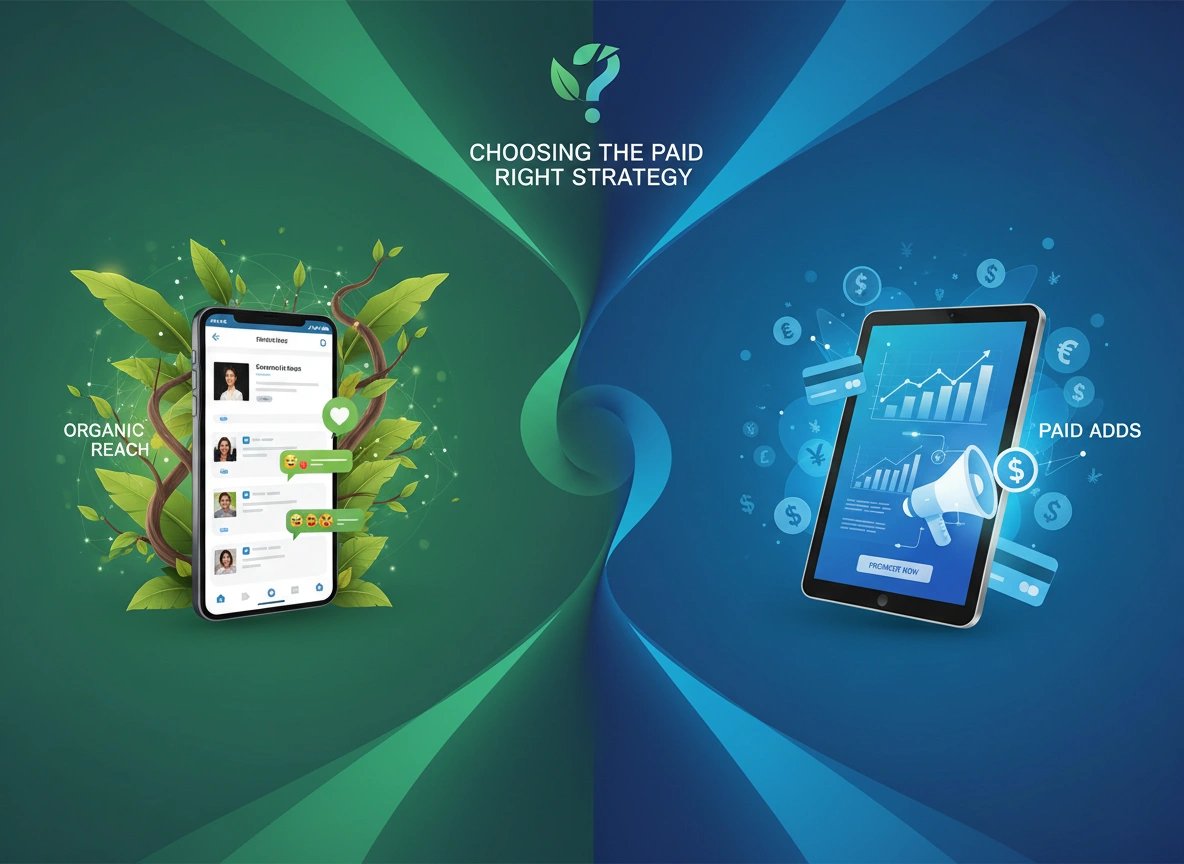
It’s the classic debate: organic versus paid Organic Social Media Marketing.
The truth is, there isn’t a single “right” answer. Both strategies have distinct strengths and glaring weaknesses. Relying solely on one often leaves money on the table, while doing both poorly can drain your budget and your team’s energy.
This guide will dissect the differences between organic and paid social strategies. We will explore the benefits, the hidden challenges, and the ideal use cases for each. By the end, you will have the clarity needed to decide which approach—or combination—suits your current business goals.
Understanding Organic Social Media
Organic social media refers to the free content (posts, photos, videos, memes, stories) that you share on your social feeds. It includes your interactions with other users, your responses to comments, and the community you build without paying the platform to boost your reach.
Think of organic social as your digital personality. It’s how you demonstrate your values, share your expertise, and build trust over the long haul.
The Core Benefits of Going Organic
1. Building Authentic Relationships
You can’t buy trust; you earn it. Organic content allows you to speak directly to your audience without the sales pitch attached to an ad. When you reply to a comment or share a behind-the-scenes look at your team, you humanize your brand. This fosters loyalty. Customers who feel connected to a brand’s personality are far more likely to stick around.
2. Cost-Effectiveness
The barrier to entry is zero. It costs nothing but time to post a tweet, share a LinkedIn update, or upload an Instagram Reel. For startups with tight budgets, organic social is the most accessible way to start building a presence.
3. Long-Term Brand Equity
Ads stop working the second you stop paying for them. Organic content lives on. A helpful blog post shared on LinkedIn or an engaging YouTube tutorial can continue to drive traffic and engagement months or even years after you post it. It builds a library of value that establishes your authority in the industry.
The Challenges of Organic Reach
While “free” sounds great, organic social has a major catch: the algorithms.
Declining Reach
Social platforms are businesses. They want you to pay for visibility. Over the last decade, organic reach (the percentage of your followers who actually see your posts) has plummeted. On platforms like Facebook, average organic reach is often less than 5%. You could spend hours crafting the perfect post, only for a tiny fraction of your audience to see it.
It’s a Slow Burn
Organic growth is a marathon, not a sprint. You won’t see overnight results. It takes consistency, patience, and a lot of trial and error to build a substantial following. If you need immediate sales to keep the lights on, an organic-only strategy will likely fail you.
Resource Intensive
It might be free to post, but it isn’t free to create. High-quality organic content requires time, creativity, and often a dedicated social media manager. If you aren’t posting consistently, the algorithms will punish you by showing your content to fewer people.
When to Prioritize Organic
- Community Management: You want to nurture existing customers and reduce churn.
- Brand Awareness: You want to establish a voice and personality in the market.
- Customer Service: You need a channel to answer questions and resolve complaints publicly.
Understanding Paid Social Media
Paid social media involves spending money to have your content shared with specific new audiences who are likely to be interested in your product. This includes sponsored posts, display ads, video ads, and boosted posts.
If organic is your personality, paid social is your megaphone. It amplifies your message and ensures it reaches the people you want to target, regardless of whether they follow you.
The Core Benefits of Paid Advertising
1. Immediate Results
Paid social cuts the line. Once you launch a campaign, your content appears in feeds immediately. This is crucial for time-sensitive promotions, product launches, or seasonal sales. You don’t have to wait months to build an audience; you can rent one instantly.
2. Laser-Focused Targeting
This is the superpower of paid social. Platforms like Facebook, LinkedIn, and TikTok have incredible amounts of data on their users. You can target audiences based on:
- Demographics: Age, location, gender, job title.
- Interests: Hobbies, pages they like, software they use.
- Behaviors: Past purchase behavior, device usage.
This precision ensures your budget is spent on people who are actually likely to buy, rather than casting a wide net and hoping for the best.
3. Scalability
If an ad is working, you can scale it. If you spend $100 and make $200 in sales, you can theoretically spend $1,000 to make $2,000. Paid social allows you to predict revenue and scale your marketing efforts in a way that organic reach simply cannot match.
The Challenges of Paid Media
It Requires a Budget
Obviously, you need money. In competitive industries, the cost per click (CPC) can be high. If you don’t have a clear monetization strategy or a high enough customer lifetime value, you can burn through cash quickly without seeing a return on investment (ROI).
Ad Fatigue
People get tired of seeing the same ads. To maintain performance, you need to constantly refresh your creative assets (images, videos, copy). This adds a layer of production cost and effort to your campaigns.
Complexity and Learning Curve
Running a successful ad campaign isn’t as simple as hitting “boost.” You need to understand bidding strategies, pixel tracking, A/B testing, and conversion optimization. A poorly managed campaign can waste thousands of dollars in days.
When to Prioritize Paid
- Lead Generation: You need to capture emails or sign-ups quickly.
- Retargeting: You want to show ads to people who visited your website but didn’t buy.
- New Customer Acquisition: You need to reach people who have never heard of your brand.
Key Differences at a Glance
To make the decision easier, let’s look at a direct comparison of the two strategies across critical business metrics.
|
Feature |
Organic Social Media |
Paid Social Media |
|---|---|---|
|
Cost |
Time & Creativity (Labor) |
Budget (Media Spend) + Labor |
|
Speed |
Slow, cumulative growth |
Instant visibility |
|
Targeting |
Limited to followers & hashtags |
Highly specific (Demographics, Interests) |
|
Content Lifespan |
Long-term (Searchable) |
Short-term (Stops when you stop paying) |
|
Goal |
Brand loyalty, engagement |
Conversions, leads, sales |
|
Measurement |
Engagement rate, shares |
ROI, ROAS (Return on Ad Spend), CPA |
Statistics You Should Know
Data helps clarify the picture. Recent industry reports highlight the current state of social marketing:
- Organic Reach is Down: The average reach for an organic Facebook post is down to 4.32%. If you have 1,000 followers, only about 43 people see your post.
- Ad Spend is Up: Social media ad spending is projected to reach $219.8 billion in 2024. Competitors are paying to play, and saturation is increasing.
- Consumer Trust: 86% of consumers say authenticity is important when deciding what brands they like and support. This reinforces the need for organic content that feels real, not just manufactured ads.
The Hybrid Approach: Why You Need Both
The debate shouldn’t be “Organic vs. Paid.” It should be “Organic and Paid.”
The most successful businesses use a hybrid strategy. They use organic content to build a brand and paid ads to harvest the demand that the brand creates. Here is how you can integrate them for optimal results:
1. Boost Your Best Organic Content
Don’t guess what works for ads. Look at your organic analytics. Which posts got the most likes, shares, or comments? This is your audience telling you what resonates. Take that high-performing organic post and put some budget behind it to show it to a wider audience. This lowers your risk because you already know the creative is effective.
2. Use Paid to Build Organic Following
Run “Follower” campaigns. Use paid ads to target people who fit your ideal customer profile and invite them to follow your page. Once they follow you, your organic content can nurture them over time for free (or at least, without further ad spend).
3. Retargeting for Conversion
Use organic social to drive traffic to your website (e.g., sharing a blog post). Then, use paid ads to retarget the people who read that blog post with a specific product offer. These people are “warm” leads—they already know who you are—so they are much cheaper to convert than cold traffic.
4. A/B Test with Organic
Before launching a massive ad campaign with a new headline or image, test it organically. Post two variations of a graphic on Twitter or Instagram Stories. See which one gets more engagement. Use the winner for your paid campaign.
Actionable Steps to Decide Your Mix
If you are still unsure where to allocate your resources right now, follow this simple framework:
Scenario A: Zero Budget, High Time
If you are a solopreneur or early-stage startup with no cash, go 100% organic. Focus on high-virality platforms like TikTok or LinkedIn where organic reach is still possible. engage heavily in comments on other big accounts to get noticed.
Scenario B: High Budget, Low Time
If you are an established business launching a new product and need sales now, lean 80% into paid social. Hire an agency or freelancer to manage the ads. Keep a baseline of organic posts (2-3 times a week) just so your page doesn’t look abandoned when ad traffic clicks on your profile.
Scenario C: Balanced Growth
The ideal state. Allocate a consistent budget for ads (even $500/month helps) to ensure steady lead flow. Simultaneously, commit to a content calendar that nurtures those leads. A 50/50 split in focus is healthy here.
Conclusion
Choosing between organic and paid social media is like choosing between diet and exercise. You can technically survive on just one, but you will only see peak performance if you do both.
Organic social media builds the legacy of your brand. It creates the trust that makes people comfortable buying from you. Paid social media fuels the engine, ensuring that your amazing brand is actually seen by the people who need it most.
Don’t view them as opposing forces. View them as two levers in the same machine. Start with your business goals. If you need speed, pay for it. If you need longevity and loyalty, build it organically. But ultimately, aim to master the dance between the two. That is where sustainable growth happens.