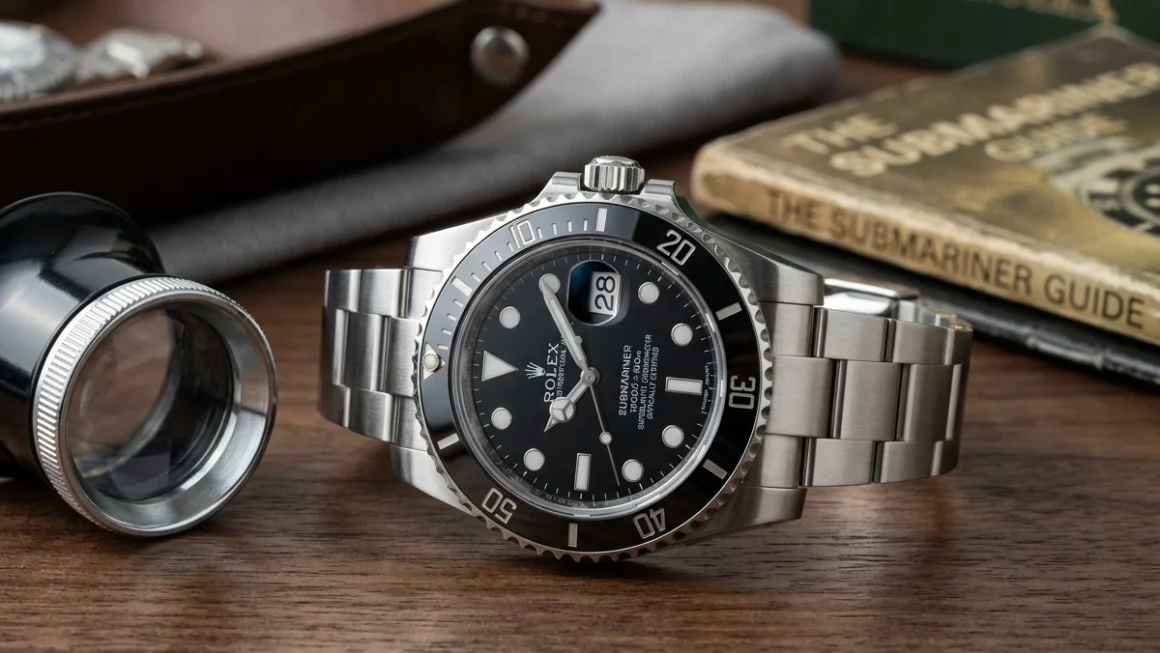
The Rolex name carries a reputation built over more than a century. That reputation rests not on marketing alone, but on the way each watch is engineered, finished, and assembled. As replica watches have grown more sophisticated, many buyers want to understand exactly what separates a genuine timepiece from an imitation. This article takes a measured, side-by-side look at build and finish, examining the small details that define quality in luxury watchmaking.
Understanding these differences helps collectors, enthusiasts, and casual observers appreciate the craftsmanship that goes into an authentic watch. It also clarifies why price gaps exist between the two categories. Let’s break down the comparison point by point.
Materials and Metal Quality
Authentic Rolex watches use proprietary alloys that the company developed in-house. The brand’s 904L stainless steel, marketed as Oystersteel, resists corrosion better than the 316L steel commonly found in the wider industry. Gold cases use Rolex’s own foundry-cast alloys, and ceramic bezels rely on a hard, scratch-resistant material that holds color over decades.
Imitation pieces often substitute standard 316L steel or lower grades. While some higher-end replicas now claim to use 904L, the consistency and purity rarely match the original. The difference shows up over time: cheaper alloys may discolor, pit, or wear at contact points. A genuine fake rolex discussion usually centers on how close these substitute materials can come, yet subtle variations in surface tone and density tend to give them away under close inspection.
Weight and Density
Weight is one of the first things an experienced hand notices. A real Rolex has a reassuring heft that comes from solid construction and dense materials throughout the case and bracelet. The balance feels deliberate, never top-heavy or hollow.
Many counterfeits feel noticeably lighter. Hollow end links, thinner case walls, and lighter movements all reduce mass. Some modern replicas add weight to mimic the original, but the distribution often feels off. Authentic watches achieve their balance through engineering rather than added filler, and that distinction is hard to fake convincingly.
Case Construction and Tolerances
Rolex machines its cases to extremely tight tolerances. The gaps between components are uniform, the edges are crisp, and the transitions between brushed and polished surfaces are clean. Each case is designed to seal against water and dust, with the Oyster case being a cornerstone of the brand’s history.
Replica cases frequently show looser tolerances. You might find uneven gaps where the caseback meets the case, slightly misaligned crown guards, or polishing that bleeds into areas meant to stay brushed. Under magnification, the machining marks on a counterfeit can appear rougher and less precise. These small inconsistencies add up to a less refined whole.
Dial Printing and Text Quality
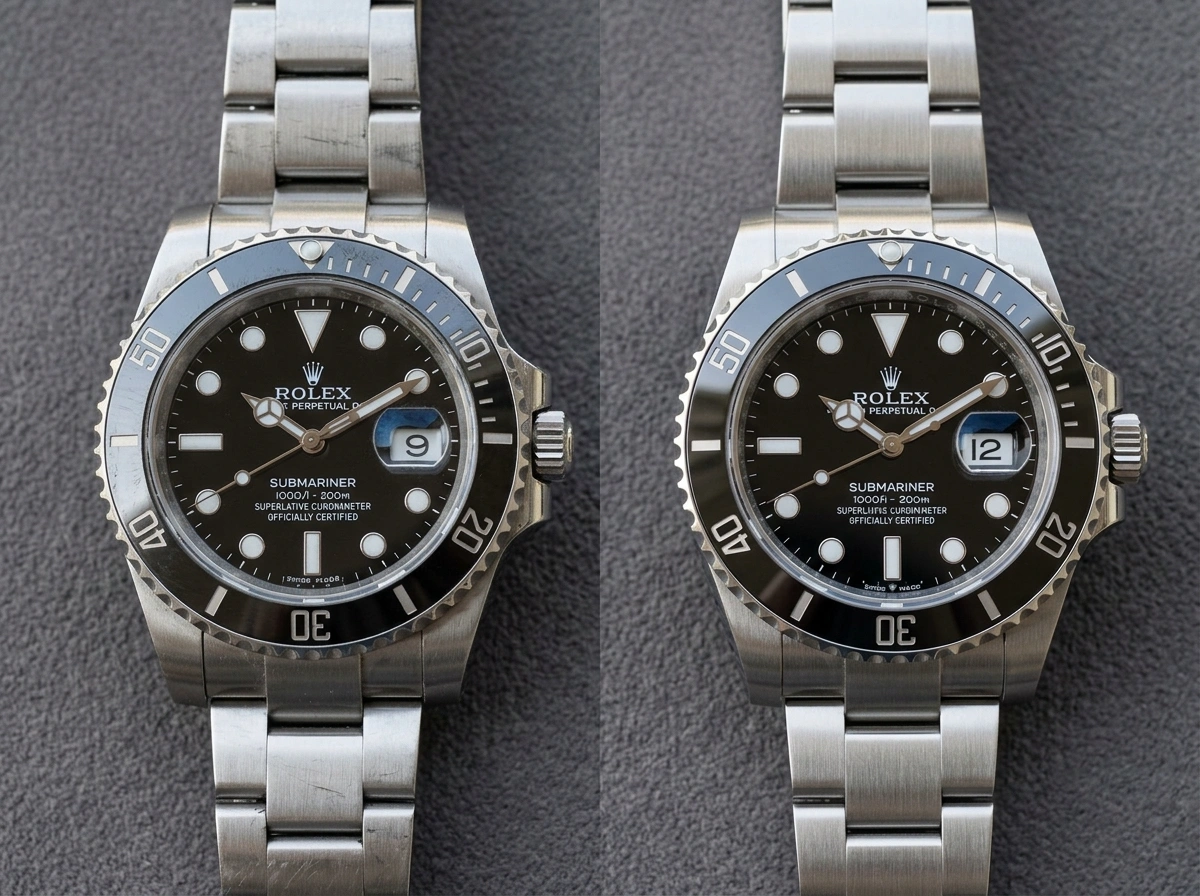
The dial is where many imitations reveal themselves. Authentic Rolex dials feature razor-sharp printing, perfectly aligned text, and applied markers set with precision. The coronet logo is crisp, with clean separation between each point of the crown. Date wheels align neatly within the cyclops window.
On counterfeits, printing can appear slightly fuzzy, uneven, or thick. Spacing between letters may vary. The minute track might not line up exactly with the markers. Color matching on the dial can be a shade off from the genuine reference. While top-tier replicas have improved dramatically, the fine print quality remains a reliable area for comparison.
Lume Application and Glow
Rolex uses Chromalight, a luminescent material that glows blue and lasts for hours in darkness. The lume is applied evenly, fills the markers completely, and shows no overflow onto the dial surface. The intensity and duration are consistent across every hour marker and hand.
Imitation lume often glows green rather than blue, or fades much faster. Application can be sloppy, with uneven thickness or visible edges. In some cases, certain markers glow brighter than others, revealing inconsistent quality control. The difference becomes obvious after a few minutes in a dark room.
Crystal and Cyclops Magnification
Genuine Rolex watches use scratch-resistant sapphire crystal. The cyclops lens over the date magnifies it roughly 2.5 times, making the date easy to read. This magnification is a hallmark of the brand and is difficult to replicate accurately.
Counterfeits sometimes use mineral glass or lower-grade sapphire that scratches more easily. The cyclops magnification on many fakes is weaker, often around 1.5 times, leaving the date looking small and distant. The bubble itself may sit at the wrong angle or distort the date slightly. These optical clues are subtle but telling.
Bracelet and Clasp Construction
A Rolex bracelet is engineered with solid links, smooth articulation, and minimal play. The clasp closes with a confident, precise click. Features like the Easylink extension or the Glidelock system show meticulous engineering, with mechanisms that feel solid and operate smoothly.
Replica bracelets may rattle, show sharp edges between links, or use hollow components. The clasp often feels flimsy and may not close with the same satisfying action. Stamping on the clasp can be shallow or uneven. Over time, weaker construction leads to stretch and wear that a genuine bracelet resists for years.
Movement and Internal Finishing
The heart of any watch is its movement, and here the gap is widest. Rolex manufactures its own calibers, finishing them to a high standard even though they remain hidden behind a solid caseback. These movements undergo rigorous chronometer testing, achieving accuracy within a few seconds per day. The components are decorated, the parts fit precisely, and reliability is exceptional.
Counterfeits typically house cheaper automatic movements, often clones or modified base calibers. Accuracy varies widely, and long-term reliability is uncertain. Internal finishing is minimal, with rough edges and basic decoration. While some replicas use functional movements, they rarely match the precision, smoothness, or longevity of an in-house Rolex caliber.
Overall Craftsmanship and Finishing
Beyond individual components, the sum of the parts matters. An authentic Rolex feels cohesive. Every surface, transition, and mechanism reflects deliberate engineering. The polishing is even, the brushing is uniform, and nothing feels rushed. This consistency is the result of decades of refinement and strict quality control.
Imitations may nail certain details while missing others. A replica might have a convincing dial but a weak clasp, or a good case with poor lume. The absence of uniform quality across every element is often the clearest sign that a watch is not genuine. Craftsmanship is holistic, and shortcuts in one area tend to ripple outward.
Conclusion
The differences between a fake and an authentic Rolex run deeper than logos and labels. They live in the alloys, the tolerances, the printing, the lume, the crystal, the bracelet, and the movement. Authentic watches earn their value through precise engineering and consistent finishing that hold up over decades of use.
While replicas continue to improve, the cumulative gap in quality remains. Materials behave differently over time. Tolerances reveal themselves under magnification. Movements separate the reliable from the uncertain. For anyone evaluating a luxury watch, understanding these build and finish details offers a clear framework for judgment. In the end, genuine craftsmanship speaks through the small things, and those details are what give an authentic Rolex its lasting appeal.
Contents