London stands as one of the most linguistically diverse cities on the planet. According to the 2021 Census, residents speak more than 100 different languages across the capital’s 32 boroughs. Furthermore, over 2.2 million people living in London were born outside the UK. This incredible international presence creates a constant exchange of information, documentation, and legal paperwork between different languages and jurisdictions.
Navigating this multinational landscape requires high levels of precision. When individuals submit foreign-language documents to government bodies, educational institutions, or legal authorities, a simple informal translation is entirely insufficient. Institutions demand verifiable, highly accurate documents to process applications and make critical decisions.
Any error or ambiguity in these documents can lead to significant delays, financial losses, or rejected applications. A standard translation cannot guarantee the strict adherence to legal terminologies and formatting required by UK institutions. As a result, professional certification becomes an absolute necessity for anyone living, working, or studying in the capital.
What is Certified Translation?
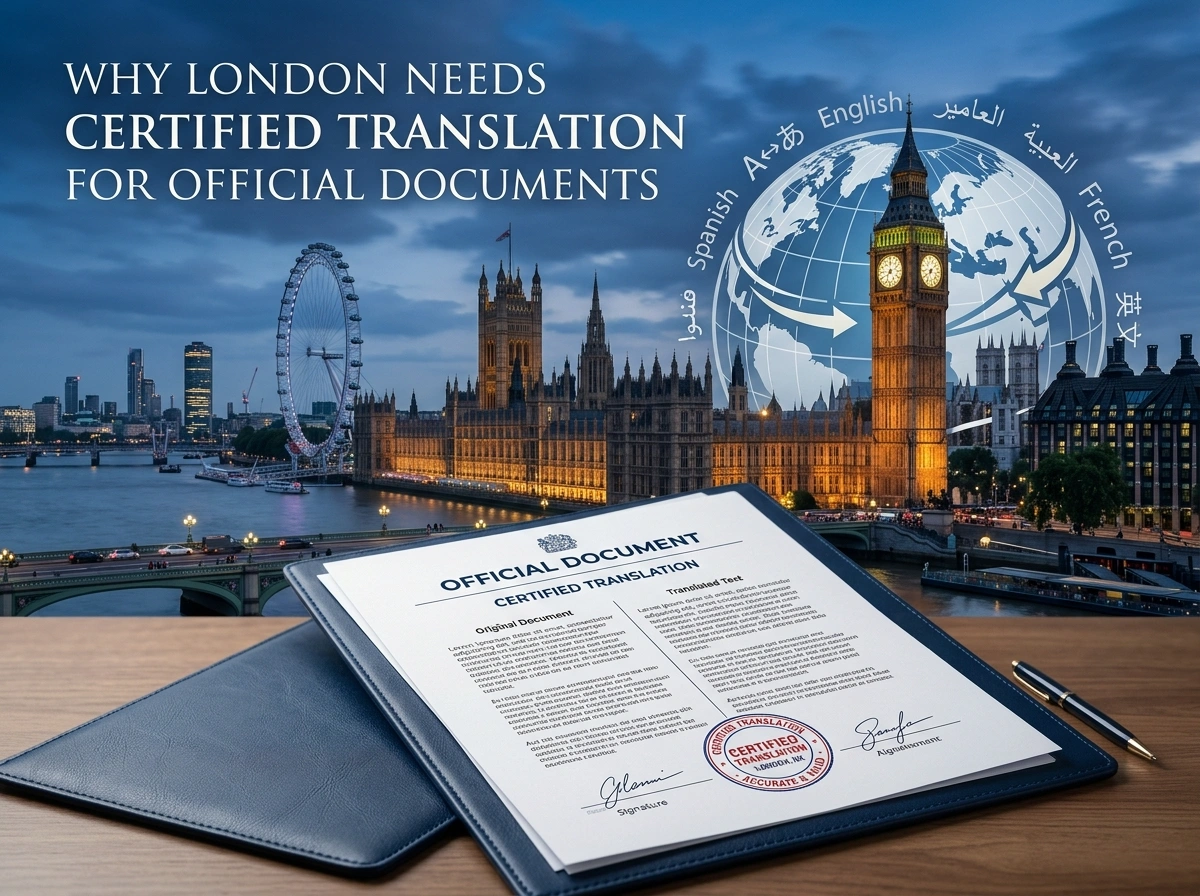
A certified translation is a formally verified document completed by a qualified professional translator. Unlike a standard translation used for casual business correspondence or website copy, a certified document includes a signed statement of accuracy. This declaration confirms that the translated text is a true, complete, and accurate representation of the original source material.
In the UK, official bodies require this certification to ensure the integrity of the information they process. The certification statement typically includes the translator’s credentials, contact information, the date of translation, and a formal signature. This provides a clear chain of accountability. If an immigration officer or a university admissions board has questions regarding the document, they can trace the translation back to a verified professional.
Why London Requires Certified Translations for Official Documents
The sheer volume of international residents in London drives a massive demand for official verification. Boroughs such as Tower Hamlets, Newham, and Ealing host large populations of residents born outside the UK, with languages like Bengali, Polish, Arabic, and Romanian frequently spoken. When these residents interact with official channels, they must present their personal histories, legal statuses, and academic backgrounds in a format recognized by British authorities.
UK institutions operate under strict procedural guidelines. The Home Office, for example, processes thousands of visa applications every week. Immigration officials do not have the resources to independently verify the accuracy of uncertified foreign documents. They rely entirely on the standardized certification process to ensure that the birth certificates, marriage licenses, and financial records they review are legitimate. Universities and courts apply similar standards to maintain their operational integrity.
Types of Official Documents Requiring Certification
Different sectors within London have specific requirements for foreign-language documents. Understanding these categories helps applicants prepare their paperwork correctly.
Legal and Court Documents
The Royal Courts of Justice, the Old Bailey, and various immigration tribunals frequently handle cases involving international evidence. Legal proceedings require exact terminology. Documents such as divorce decrees, police certificates, court summons, and powers of attorney must be translated with absolute precision. A mistranslated legal term can alter the entire context of a case, making certified translation a non-negotiable requirement for the UK legal system.
Academic Records
London is home to prestigious global institutions, including UCL, Imperial College, LSE, and King’s College London. These universities attract thousands of international students each year. During the admissions process, students must provide proof of their previous educational achievements. This involves submitting certified translations of academic transcripts, diplomas, and language qualification certificates. Universities use these documents to verify that applicants meet their stringent academic entry requirements.
Immigration and UKVI Paperwork
UK Visas and Immigration (UKVI) enforces some of the strictest documentation rules in the country. Individuals applying for spouse visas, work permits, or Indefinite Leave to Remain must provide comprehensive evidence of their identity and financial standing. Commonly translated documents include birth certificates, marriage certificates, bank statements, and medical records. All of these must carry a formal certification statement to be accepted by the Home Office.
Business and Corporate Files
London’s status as a global financial hub means that businesses routinely deal with cross-border transactions and international employment. Companies bringing talent from overseas must process foreign employment contracts and professional qualification certificates. Regulatory bodies, such as the General Medical Council or the Solicitors Regulation Authority, also demand certified translations of foreign qualifications before granting professional registration to international workers.
The Legal and Regulatory Landscape in the UK
The UK regulatory landscape heavily emphasizes accountability. Unlike some European countries that utilize a system of “sworn translators” appointed by a court, the UK relies on qualified professionals working through recognized translation agencies. These professionals self-certify their work according to guidelines set out by government agencies.
For documents intended for use outside the UK, the regulatory landscape involves an additional step known as an Apostille. If a London resident needs to submit a UK-certified translation to a country that is a member of the 1961 Hague Convention, the translation must often receive an Apostille certificate from the Foreign, Commonwealth & Development Office (FCDO). This verifies the authenticity of the translator’s signature for international authorities.
Benefits of Using Professional certified translation services london
Attempting to navigate official requirements without professional help is highly risky. Working with established experts provides peace of mind and guarantees institutional compliance. By choosing professional certified translation services london, applicants ensure their documents meet the exact formatting and certification standards demanded by UKVI, courts, and universities.
Professional agencies maintain vast networks of linguists covering over 100 languages, from widely spoken languages like Polish and Spanish to specific regional dialects. They understand the nuances of legal and medical terminology. Furthermore, established services offer fast turnaround times, which is essential for applicants facing tight immigration deadlines or impending court dates. Secure digital delivery methods also protect sensitive personal data during the translation process.
Risks of Non-Certified or Poor Quality Translations
Submitting a poorly translated or uncertified document to an official body carries severe consequences. The most immediate risk is the outright rejection of an application. The Home Office routinely denies visa applications if the supporting evidence fails to meet their strict formatting rules. A rejected visa can lead to lost application fees, disrupted travel plans, and significant emotional distress.
In an academic context, failing to provide a properly certified transcript can result in a student losing their place at a university. In legal settings, courts may refuse to admit uncertified documents as evidence, potentially jeopardizing an entire legal case. Even minor formatting errors or missing certification statements can cause weeks of administrative delays while the applicant attempts to secure a compliant replacement.
How to Choose the Right Translation Service in London
Selecting a reliable translation provider requires careful consideration of several key factors. Applicants should evaluate agencies based on their track record with UK authorities.
First, verify that the agency explicitly states their translations are accepted by the Home Office, UKVI, and major universities. Look for providers that offer services across a wide range of languages and possess subject-matter expertise in the specific type of document you need translated.
Second, consider the turnaround time and delivery methods. Immigration and legal matters operate on strict timelines. A reputable agency should offer clear delivery windows, usually within one to three business days, and provide secure digital copies. Finally, review their pricing structure. Professional services typically offer transparent, per-page pricing without hidden fees, allowing applicants to budget accurately for their administrative costs.
Ensuring Compliance and Accuracy
Living, working, or studying in London requires navigating a complex web of administrative and legal requirements. For the millions of residents dealing with foreign-language documents, precision is paramount. Professional certified translation bridges the gap between international documentation and strict UK regulations.
By understanding the requirements of local institutions, individuals can approach their applications with confidence. Securing an accurate, fully compliant translation eliminates unnecessary risks and administrative hurdles. Ensure your documents are processed by qualified professionals to maintain your peace of mind and keep your official applications moving forward smoothly.